

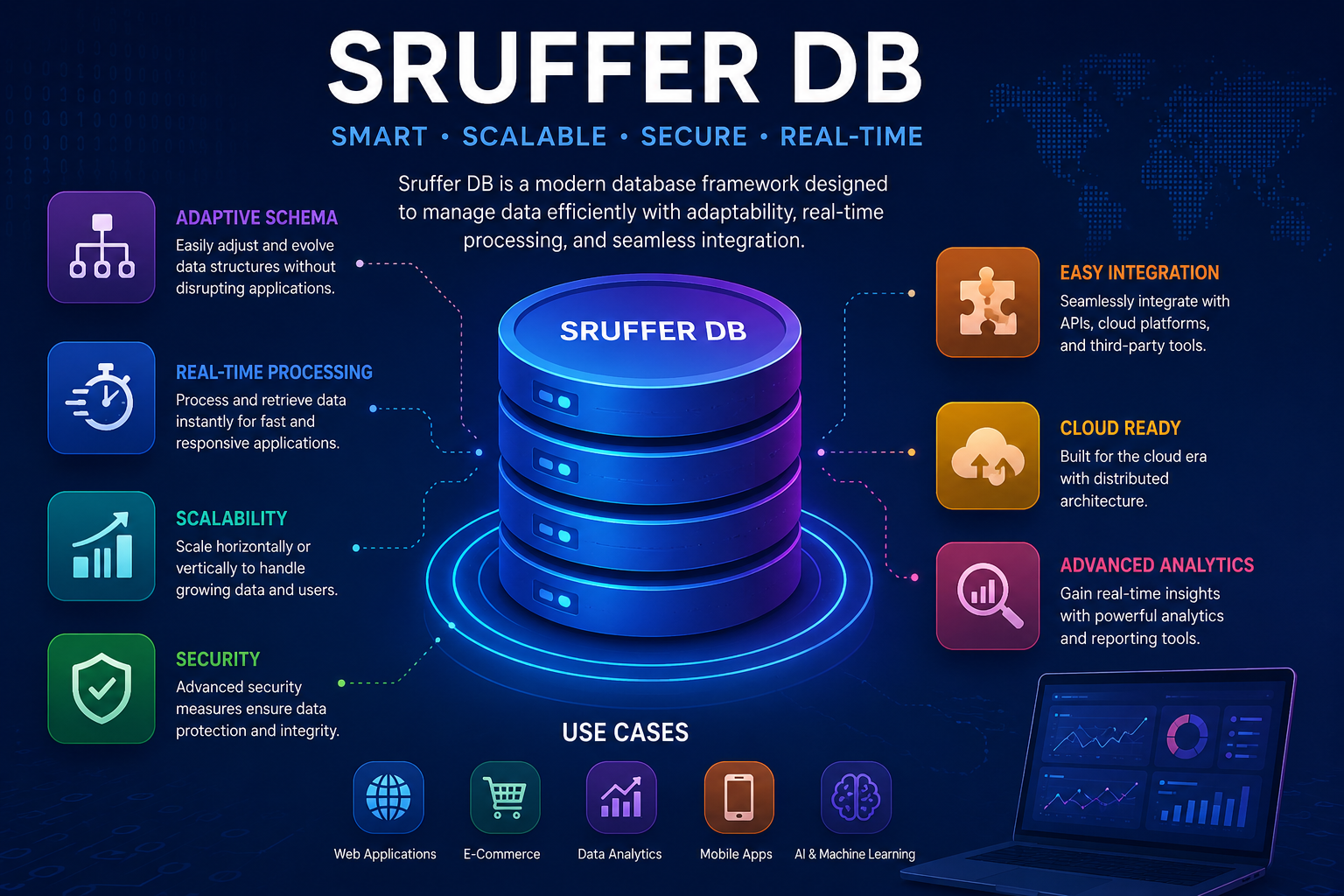
In today’s digital era, data is no longer just a supporting element—it is the foundation upon which modern systems are built. From websites and applications to artificial intelligence and cloud computing, everything relies on structured and well-managed data. Within this evolving landscape, the concept of Sruffer DB is gaining attention as a flexible and forward-thinking approach to handling digital information. While it may sound unfamiliar at first, Sruffer DB represents a broader shift toward smarter, more adaptive database systems that prioritize efficiency, scalability, and user-centric design.
This article takes a deep dive into Sruffer DB, exploring its meaning, possible applications, architecture, advantages, and its role in shaping the future of digital ecosystems.
Understanding Sruffer DB
At its core, Sruffer DB can be understood as a modern database framework or concept designed to manage structured and unstructured data in a more intelligent way. Unlike traditional databases that rely heavily on rigid schemas and predefined structures, Sruffer DB emphasizes adaptability. It is built to evolve alongside the needs of users and applications.
The term itself suggests a blend of “structured” and “buffered” or “surfaced” data handling—indicating a system that not only stores data but also makes it easily accessible, dynamic, and responsive. Instead of treating data as static entries in tables, Sruffer DB views data as an active component that interacts with applications in real time.
The Evolution of Database Systems
To fully understand the significance of Sruffer DB, it’s important to consider how database systems have evolved over time.
Early databases were simple and rigid, focusing on storing information in tables with fixed relationships. As technology advanced, relational databases became dominant, offering better organization and query capabilities. However, with the rise of big data, social media, and real-time applications, traditional systems began to show limitations.
This led to the emergence of NoSQL databases, cloud-based storage, and distributed systems. Sruffer DB fits into this progression as a next-generation approach that combines the strengths of multiple database types while addressing their weaknesses.
It represents a move toward systems that are not just storage solutions but intelligent platforms capable of adapting to changing demands.
Key Features of Sruffer DB
One of the defining aspects of Sruffer DB is its feature set, which reflects modern technological needs.
Adaptive Data Structuring
Unlike rigid schemas, Sruffer DB allows data structures to evolve. This means developers can modify or expand data models without disrupting existing systems.
Real-Time Processing
Sruffer DB is designed for speed. It supports real-time data analysis and queries, making it ideal for applications that require instant feedback, such as analytics dashboards or live platforms.
Scalability
As businesses grow, their data grows with them. Sruffer DB supports horizontal and vertical scaling, ensuring that performance remains consistent even with massive datasets.
Integration-Friendly Design
Modern applications often rely on multiple services working together. Sruffer DB is built to integrate seamlessly with APIs, cloud platforms, and external tools.
Security and Data Integrity
With increasing concerns about data privacy, Sruffer DB incorporates advanced security mechanisms to protect sensitive information while maintaining accuracy and consistency.
Architecture Behind Sruffer DB
The architecture of Sruffer DB is what sets it apart from traditional systems. Instead of a single centralized structure, it often uses a distributed model.
In this setup, data is stored across multiple nodes or servers. Each node communicates with others, ensuring that data remains consistent and accessible. This distributed approach enhances reliability—if one node fails, others can take over without disrupting the system.
Additionally, Sruffer DB may utilize layered architecture:
- Data Layer: Handles storage and retrieval
- Logic Layer: Processes queries and operations
- Interface Layer: Connects with applications and users
This separation allows for better performance and easier maintenance.
Advantages Over Traditional Databases
Sruffer DB offers several advantages that make it appealing in modern digital environments.
One major benefit is flexibility. Traditional databases often require extensive planning before implementation. Sruffer DB, on the other hand, allows for gradual development and adaptation.
Another advantage is performance. With real-time processing and distributed architecture, it can handle large volumes of data without slowing down.
It also improves user experience. Faster data retrieval and dynamic updates mean that applications feel more responsive and engaging.
Finally, Sruffer DB supports innovation. Developers can experiment with new features and ideas without being constrained by rigid structures.
Challenges and Considerations
Despite its benefits, Sruffer DB is not without challenges.
One potential issue is complexity. Distributed systems can be harder to manage and require skilled professionals to maintain them.
Another challenge is cost. Advanced infrastructure and scalability features may require higher initial investment.
There is also the question of compatibility. While Sruffer DB is designed for integration, transitioning from older systems may require careful planning.
Security, while strong, must be continuously updated to keep up with evolving threats.
The Role of Sruffer DB in Digital Transformation
Digital transformation is about more than just adopting new technology—it’s about rethinking how systems operate. Sruffer DB plays a crucial role in this process by enabling organizations to handle data more effectively.
With its adaptive structure, businesses can respond to changing market conditions. Real-time insights allow for quicker decision-making, while scalable architecture ensures long-term growth.
In essence, Sruffer DB acts as a bridge between traditional data systems and the demands of modern digital environments.
Future Potential of Sruffer DB
Looking ahead, the potential of Sruffer DB is significant.
As technologies like the Internet of Things (IoT), blockchain, and AI continue to grow, the need for flexible and efficient data systems will increase. Sruffer DB is well-positioned to meet these demands.
We can expect future developments to include enhanced automation, smarter data processing, and even greater integration with emerging technologies.
The concept may also evolve into industry-specific solutions, tailored to sectors such as healthcare, finance, and education.
Best Practices for Implementing Sruffer DB
For those considering adopting Sruffer DB, certain best practices can help ensure success.
Start with a clear understanding of your data needs. Identify what type of data you will handle and how it will be used.
Invest in skilled professionals who understand modern database systems and distributed architecture.
Focus on security from the beginning. Implement strong encryption and access controls to protect sensitive information.
Regularly monitor performance and make adjustments as needed. This ensures that the system remains efficient and reliable.
Finally, plan for scalability. Design your system in a way that allows for growth without major disruptions.
Conclusion
Sruffer DB represents a new way of thinking about data management. It moves beyond the limitations of traditional databases, offering a flexible, scalable, and intelligent approach to handling information.
As digital systems continue to evolve, the importance of efficient data management will only increase. Sruffer DB provides a framework that not only meets current needs but also prepares for future challenges.
Whether used in web development, analytics, or advanced technologies, it has the potential to transform how data is stored, processed, and utilized.
