

The global shift toward renewable energy has placed solar power at the center of modern electricity generation. Among the many innovations driving this transition, HMS Photovoltaik systems have gained significant attention for their efficiency, reliability, and smart energy management capabilities. As households and businesses increasingly look for sustainable alternatives to traditional power sources, understanding HMS Photovoltaik technology becomes essential.
This article explores what HMS Photovoltaik is, how it works, its advantages, real-world applications, and why it is becoming a preferred choice in solar energy systems today.
Understanding HMS Photovoltaik
HMS Photovoltaik refers to a modern microinverter-based solar energy system that is commonly associated with advanced solar solutions developed for module-level optimization. The term “HMS” is widely linked to microinverter technology, particularly systems designed to convert direct current (DC) generated by solar panels into alternating current (AC) at the individual panel level.
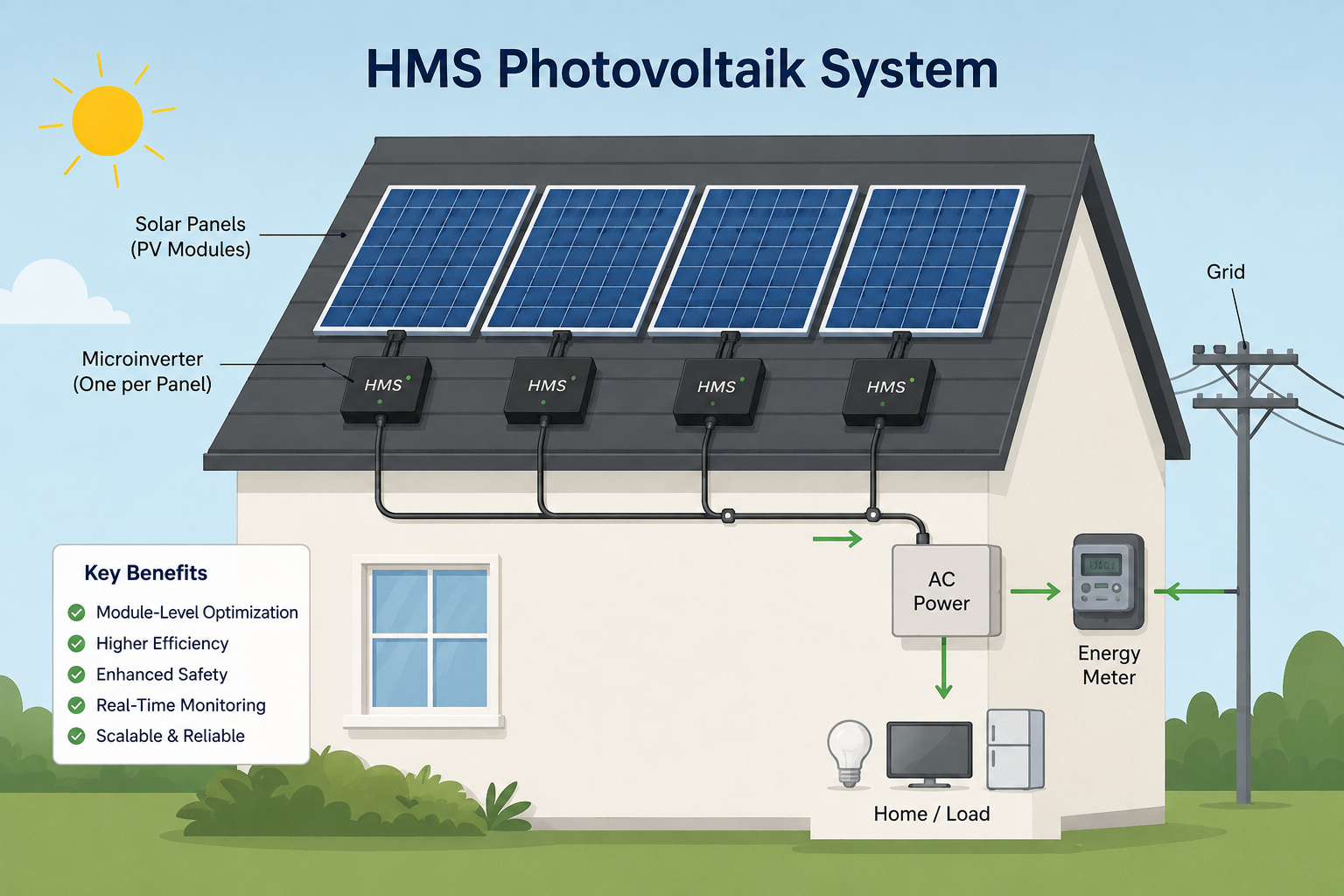
Unlike traditional string inverter systems where multiple solar panels are connected to a single inverter, HMS Photovoltaik systems use a decentralized approach. Each solar module operates independently, equipped with its own microinverter. This allows for better performance monitoring, higher efficiency, and reduced energy loss.
In simple terms, HMS Photovoltaik ensures that every Solar panel works at its maximum potential regardless of shading, orientation, or environmental conditions affecting other panels.
How HMS Photovoltaik Systems Work
To understand the importance of HMS Photovoltaik, it is necessary to look at its working mechanism.
Each solar panel in the system is connected to a small microinverter. This microinverter immediately converts the DC electricity generated by the panel into usable AC electricity. The AC power is then either used in the home, stored in a battery system, or fed into the electrical grid.
This structure eliminates the need for a central inverter, which is often a single point of failure in traditional solar systems. It also allows real-time monitoring of each panel’s performance through smart communication systems.
Another important feature is maximum power point tracking (MPPT) at the module level. This ensures that every panel operates at its highest possible efficiency independently of others in the system.
Key Features of HMS Photovoltaik Technology
HMS Photovoltaik systems are designed with advanced features that distinguish them from conventional solar solutions.
One of the most important features is module-level optimization. Since each panel operates independently, issues like partial shading or dust accumulation on one panel do not significantly affect the overall system output.
Another critical feature is enhanced safety. Because the system operates at lower DC voltage before conversion, the risk of electrical hazards is significantly reduced compared to traditional high-voltage string systems.
Additionally, HMS systems offer real-time monitoring capabilities. Users can track energy production for each panel individually, often through mobile applications or online platforms. This transparency helps in better maintenance and performance optimization.
Durability and scalability are also key strengths. HMS Photovoltaik systems can easily be expanded by adding more panels without redesigning the entire system.
Advantages of HMS Photovoltaik
The growing popularity of HMS Photovoltaik is largely due to its multiple advantages in both residential and commercial settings.
One of the primary benefits is higher energy efficiency. Since each panel operates independently, energy loss due to mismatch or shading is minimized. This often results in higher total energy output compared to string inverter systems.
Another advantage is improved system reliability. In traditional setups, if the central inverter fails, the entire system stops working. In HMS Photovoltaik systems, the failure of one microinverter does not affect the rest of the system.
Ease of installation is also a major benefit. The modular design simplifies installation and reduces wiring complexity. This can also lower installation costs and time.
From a maintenance perspective, HMS systems are easier to manage. Since performance data is available at the panel level, identifying and fixing issues becomes faster and more precise.
Finally, scalability makes HMS Photovoltaik highly future-proof. Whether for small homes or large commercial rooftops, the system can grow with energy demands.
Applications of HMS Photovoltaik Systems
HMS Photovoltaik technology is widely used in various sectors due to its flexibility and performance advantages.
In residential applications, homeowners prefer HMS systems for rooftop solar installations. These systems are ideal for rooftops with partial shading or complex layouts.
In commercial and industrial sectors, HMS Photovoltaik supports large-scale energy production with better monitoring and fault detection capabilities. Businesses benefit from reduced downtime and improved energy management.
Agricultural applications are also increasing. Farms and rural installations often face uneven sunlight exposure, making microinverter systems more efficient than traditional setups.
Additionally, HMS systems are increasingly used in smart energy grids, where decentralized energy production plays a key role in balancing supply and demand.
HMS Photovoltaik vs Traditional Solar Systems
Comparing HMS Photovoltaik with traditional string inverter systems highlights its technological advantages.
In traditional systems, solar panels are connected in series, meaning the performance of the entire string depends on the weakest panel. If one panel is shaded or underperforming, it reduces the output of the whole system.
In contrast, HMS Photovoltaik systems operate independently at the panel level. This ensures consistent performance even if some panels are affected by external conditions.
Traditional systems also rely on a central inverter, which can be a single point of failure. HMS systems eliminate this risk by distributing conversion across multiple microinverters.
While traditional systems may have lower initial costs, HMS Photovoltaik often provides better long-term value due to higher efficiency and lower maintenance requirements.
Challenges and Considerations
Despite its advantages, HMS Photovoltaik systems also come with certain considerations.
One of the main concerns is initial cost. Microinverter-based systems are generally more expensive upfront compared to string inverter setups. However, this cost is often offset by higher energy production and lower maintenance over time.
Another factor is installation complexity in terms of component management. Although wiring is simpler, each panel requires its own inverter, which means more hardware components overall.
Compatibility and system design must also be carefully planned to ensure optimal performance. Choosing high-quality components and professional installation is crucial for long-term reliability.
The Future of HMS Photovoltaik
The future of HMS Photovoltaik is closely tied to global renewable energy trends. As solar technology continues to evolve, microinverter systems are expected to become more efficient, affordable, and intelligent.
Integration with smart home systems and energy storage solutions is already becoming more common. This allows users to manage energy consumption more effectively and even achieve partial or full energy independence.
Artificial intelligence and data analytics are also being introduced into solar monitoring systems, enabling predictive maintenance and performance optimization.
With increasing demand for clean energy and decentralized power systems, HMS Photovoltaik is likely to play a major role in shaping the future of solar energy infrastructure.
Conclusion
HMS Photovoltaik represents a significant advancement in solar energy technology. By shifting from centralized to decentralized energy conversion, it offers higher efficiency, improved safety, and better system reliability.
While the initial investment may be higher, the long-term benefits in energy production, maintenance, and scalability make it a strong choice for both residential and commercial users.
As the world continues to move toward sustainable energy solutions, HMS Photovoltaik stands out as a modern, intelligent, and future-ready approach to harnessing solar power.
